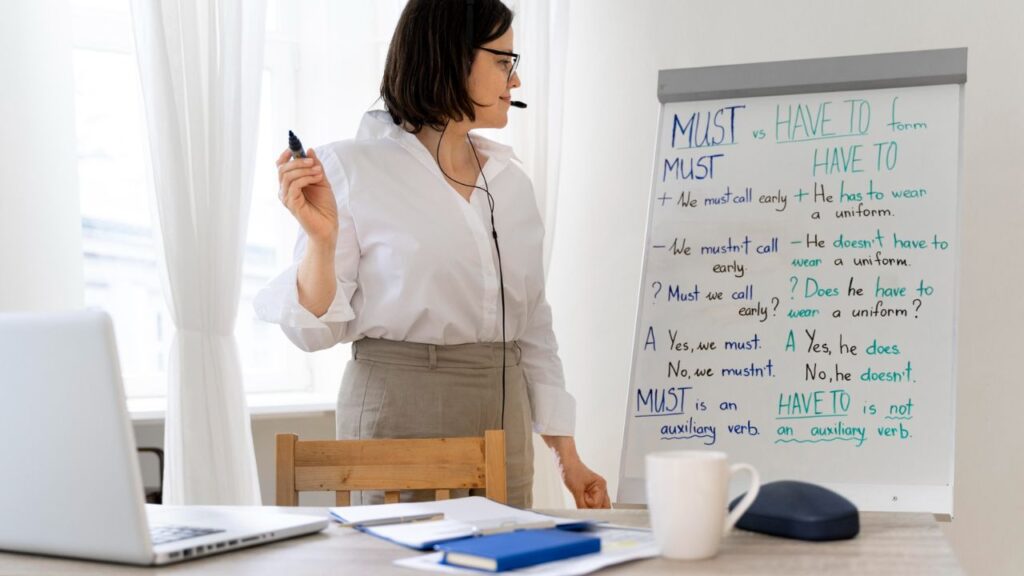
Most beginners think Business English is about sounding formal or using big corporate words. That belief quietly ruins confidence. In real offices, people don’t speak like textbooks—they speak clearly, politely, and efficiently. If your English helps work move forward, it’s good Business English. Simple as that.
I’ve watched beginners panic in meetings, overthink emails, and stay silent because they didn’t know the “right” words. The truth? You only need a small set of structures and phrases to function professionally. This guide shows you exactly what matters—and what doesn’t.
What Business English Really Means (For Beginners)

Business English is not advanced English. It’s purpose-driven English.
It focuses on:
- Clear communication
- Polite tone
- Professional structure
- Predictable phrases
It avoids:
- Slang
- Emotional language
- Overly complex sentences

Government and workplace language programs in the US and UK define professional English primarily as clarity and appropriateness, not complexity: https://www.usa.gov/learn-english
Once you understand this, Business English becomes manageable—even for beginners.
Core Rule: Simple English Sounds More Professional
Here’s a rule that surprises beginners:

Short, clear sentences sound more professional than long ones.
Bad:
“I am writing this email in order to inform you about the fact that there might possibly be a delay.”
Good:
“I’m writing to inform you that there may be a delay.”
Professional English cuts unnecessary words. Managers appreciate that.
Business Emails for Beginners (The Only Structure You Need)
You don’t need different formats for every email. One structure works for 80% of situations.
Simple Professional Email Structure
- Polite opening
- Purpose of the email
- Key details
- Polite closing
That’s it.
Example: Simple Work Email
Subject: Project Update
Hello John,
I hope you’re doing well. I’m writing to share a quick update on the project. The first draft is complete, but we may need two more days for review. Please let me know if that works for you.
Best regards,
[Your Name]
Clear. Polite. Professional.
The British Council recommends this direct structure for workplace emails, especially for non-native speakers: https://learnenglish.britishcouncil.org
Essential Business Email Phrases (Beginner-Friendly)
Memorize these. Use them everywhere.
Openings
- I’m writing to…
- I hope you’re doing well.
- This email is regarding…
Requests
- Could you please…
- I would appreciate it if you could…
- Please let me know if…
Updates
- I wanted to update you on…
- The current status is…
- We are still waiting for…
Closings
- Please let me know if you have any questions.
- Looking forward to your response.
- Thank you for your time.
You don’t need more at the beginner stage.
Business Meetings: What Beginners Actually Need to Say
Meetings scare beginners because they think they must speak a lot. That’s wrong.
In most meetings, beginners only need to:
- Agree
- Clarify
- Update
- Ask simple questions
That’s professional participation.
Useful Meeting Phrases
Giving Opinions (Simple)
- I think this is a good idea.
- In my opinion, this could work.
- I agree with that point.
Asking for Clarification
- Could you explain that again?
- Sorry, I didn’t catch that.
- What do you mean by…?
Giving Updates
- I’m currently working on…
- The task is almost finished.
- There’s a small issue with…
These phrases are widely used in international workplaces and recommended in Cambridge Business English materials: https://www.cambridgeenglish.org
How to Speak in Meetings Without Feeling Stupid
Here’s a secret professionals won’t tell you.
You don’t need long answers.
Good meeting English is often:
- Short
- Calm
- Direct
Instead of:
“I think that maybe we should possibly consider changing the timeline.”
Say:
“I think we should adjust the timeline.”
Confidence comes from clarity, not length.
Professional Phrases Every Beginner Should Know
These phrases make your English sound instantly more professional.
| Casual | Professional |
|---|---|
| I want | I would like |
| Tell me | Please let me know |
| But | However |
| So | Therefore |
| Thanks | Thank you |
Small changes. Big impact.
Cambridge Dictionary is helpful for checking whether a phrase is formal or informal before using it at work: https://dictionary.cambridge.org
Telephone & Video Call English (Beginner Survival Kit)
Calls are harder than emails because there’s no time to think.
Use safe phrases.
Starting a Call
- Hello, this is [Name] calling from…
- Thank you for taking the call.
If You Don’t Understand
- Could you repeat that, please?
- The line is not very clear.
- Could you speak a bit more slowly?
Ending a Call
- Thank you for your time.
- I’ll follow up by email.
- Have a great day.
These phrases are standard in global business environments.
Common Business English Mistakes Beginners Make
Let’s save you embarrassment.
1. Being Too Informal Too Early
Avoid:
- Hey
- What’s up
- No problem (use “You’re welcome” instead)
2. Over-Apologizing
Don’t say “sorry” for everything.
Instead of:
“Sorry for bothering you.”
Say:
“Thank you for your time.”
3. Trying to Sound Smart
Big words increase mistakes.
Simple English sounds confident. Complex English sounds risky.
A Simple Daily Business English Practice Plan
You don’t need hours.
| Time | Practice |
|---|---|
| 5 min | Read one business email |
| 5 min | Rewrite it simply |
| 5 min | Say one meeting update aloud |
| 5 min | Review 3 professional phrases |
20 minutes a day builds real workplace confidence.
How Long Does It Take to Improve Business English?
With daily use:
- 1 week: Emails feel easier
- 2–3 weeks: Meetings less scary
- 1 month: Clear professional communication
- 3 months: Confident workplace English
Progress shows fastest when you use English at work, not just study it.
FAQs:
Do beginners need advanced vocabulary for business English?
No. Clear, simple words are preferred in professional settings.
Is it okay to make grammar mistakes at work?
Minor mistakes are acceptable if your message is clear.
How can I sound more polite in emails?
Use modal verbs like “could,” “would,” and polite closings.