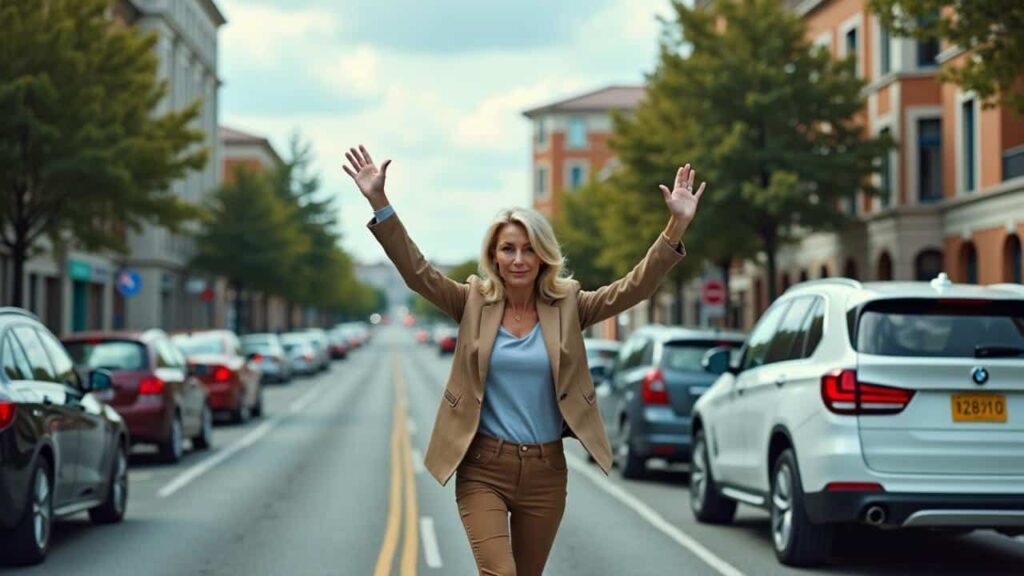
The light turns red, traffic stacks up, and you step off the curb a half-second faster than planned. A car brakes, stops just short of the white line. You feel that small rush of relief that still sneaks up on you, even as an adult. Almost without thinking, your hand lifts. Not a full wave—just a quick flick of the fingers. Thanks. The driver nods. You’re across in three seconds, and the moment dissolves.
Psychologists are paying close attention to that tiny exchange. Because buried inside it is a surprisingly reliable clue about how a person is wired.
The two kinds of people at a crosswalk

Stand at a busy intersection long enough and a pattern emerges. Some pedestrians cross as if cars don’t exist—eyes forward, pace steady, no acknowledgment. Others glance toward the driver, raise a hand, nod, or flash a quick smile.
Same city. Same traffic laws. Same crosswalk.
Very different micro-behavior.

In psychology, these moments are called “thin slices”—brief, almost invisible actions that reveal deeper personality traits. The thank-you wave is one of the cleanest thin slices urban researchers have found.
A Dutch observational study that tracked hundreds of real crossings—not lab simulations—noticed a repeatable split. People who waved or nodded tended to score higher on agreeableness and conscientiousness, two core traits in the Big Five personality framework used by psychologists worldwide (outlined by the American Psychological Association: https://www.apa.org).
They were also more likely to describe themselves, later, as “someone who notices others” or “someone who feels uncomfortable being rude.”

One researcher recalled a man filmed at the same intersection over several days. Every time a car stopped, he offered the same almost shy hand lift. Nothing theatrical. Just automatic. When interviewed, he shrugged and said, “It feels wrong to walk on like a king.”
That sentence tells you more than a personality test ever could.
What the wave quietly says about your worldview
From a psychological perspective, the wave isn’t about manners. It’s about how you mentally model the world.
People who offer that small acknowledgment tend to see public space as shared rather than contested. Even when the law is fully on their side, they register that the driver gave up time, momentum, and attention to let them pass.
Psychologists call this micro-acknowledgment: a split-second signal that says, “I saw what you did, and it mattered.” It’s a hallmark of social reciprocity—the instinct to respond to cooperation with recognition.
Those who don’t wave aren’t villains. Their attention is usually pointed elsewhere. Destination over interaction. Task over relationship. In many cases, they’re simply overloaded.
Think about two mornings. On one, you’re late, your phone is buzzing, your shoulders are tight. A car stops. You hurry across, eyes locked on the far curb. No wave.
On another morning, you’re early. Coffee worked. Same car, same stop. This time, your head turns. Hand lifts. Small nod.
Same person. Different inner state.
That’s why psychologists warn against judging individuals by a single moment. Stress, fatigue, or safety concerns all suppress visible politeness. Yet when researchers average behavior over time—dozens or hundreds of crossings—the signal stabilizes.
Frequent wavers also tend to hold doors, adjust bags on crowded trains, or step aside on narrow sidewalks. Many report a mild internal discomfort when they feel they’ve failed to acknowledge someone in public.
That discomfort is telling. It means their sense of fairness isn’t situational. It’s internalized.
Culture changes the gesture, not the meaning
The exact form of the “thank you” isn’t universal. In some countries it’s a full hand wave. In others, a nod, brief eye contact, or even a subtle head tilt replaces it. Traffic psychology research across Europe and East Asia shows the movement varies, but the intent is constant: acknowledgment.
Transport behavior studies summarized by the OECD (https://www.oecd.org/transport) note that pedestrian-driver interactions with visible acknowledgment reduce perceived conflict, even when traffic flow stays the same.
Across cultures, the same association keeps resurfacing. People who acknowledge tend to describe public space as cooperative rather than hostile. Streets, in their mind, are relationships—not battlegrounds.
Using a two-second habit to shape who you are
Here’s where the research gets interesting. The wave doesn’t just reveal personality. It can also shape it.
Psychologists call this “acting into” traits. Repeated behaviors slowly pull self-image along with them. You don’t wait to feel empathetic and then act; you act, and the feeling follows.
The habit itself is almost laughably small:
Make brief eye contact if it feels safe.
Lift your hand, palm open, no drama.
Small nod.
Keep walking.
That’s it.
Many people resist this for understandable reasons. It feels awkward. Or unnecessary. Or mildly irritating. “I have the right of way,” the inner voice says. “Why should I thank someone for following the law?”
That reaction is common—and human. Cities train us to defend our space. But psychologically, the wave isn’t submission. It’s acknowledgment. It doesn’t erase your rights. It humanizes them.
Urban well-being research summarized by the World Health Organization (https://www.who.int) consistently links small prosocial acts in public spaces with lower perceived stress and loneliness, even in dense cities.
One social psychologist who studies everyday interactions put it bluntly: “Gratitude in public isn’t about politeness. It’s about reminding your brain that you live among people, not obstacles.”
The street as a personality test you never signed up for
Once you start noticing, the street feels like a live questionnaire. Do I wave? Do I ignore? Do I speed up for someone, or force them to adjust for me?
These aren’t moral tests. They’re micro-decisions. And because they’re unplanned, they’re honest.
Researchers love them for that reason. Nobody performs at a crosswalk. They’re just trying to get somewhere. Over time, patterns leak out. People who scatter small acknowledgments throughout their day consistently report feeling more connected and less “at war” with their surroundings.
Drivers notice too. Many admit that the wave matters—not logically, but emotionally. It turns a forced stop into a shared moment, however brief.
You can walk through life without any of this. The lights will still change. The cars will still stop. The law will still protect pedestrians.
But when every crossing becomes a silent transaction, something thins out. The other person becomes just an object whose relevance ends at the bumper.
Social psychologists use the phrase “social fabric” for a reason. It’s woven from threads like this—not grand gestures, but two-second acknowledgments no one records and no one remembers.
You might find that after a week of conscious waving, the real shift isn’t in how drivers respond. It’s in how you feel. Streets seem less hostile. People feel less anonymous. Your own behavior feels more aligned with the person you think you are—or want to be.
No medals. No applause. Just a quiet adjustment inside your nervous system.
Maybe that tiny thank-you wave isn’t about traffic at all. Maybe it’s a soft answer to a deeper question: who am I, when nobody’s watching?
What the research suggests
| Key point | Detail | Value for you |
|---|---|---|
| Micro-gestures reveal traits | Thank-you waves correlate with empathy, agreeableness, and reciprocity | Helps you see personality in everyday habits |
| Small acts shape identity | Repeated acknowledgment reinforces a self-image of being attentive | Offers a simple way to “train” social awareness |
| Streets are social spaces | Crossings are shared interactions, not just legal events | Makes daily commutes feel more human |
FAQs:
Does not waving make me a bad person?
No. Psychologists caution against judging individuals from single moments. Stress, distraction, or safety concerns often suppress visible politeness.
Is the thank-you wave universal?
The form varies by culture. The core element is acknowledgment, not the specific gesture.
Can forcing myself to wave really change my personality?
Over time, yes. Repeated behaviors can strengthen traits like empathy and social awareness.